Choosing a business card comes down to three things: the shape, the paper stock, and the finish. Graphics Design Media prints every option below in-house at our Las Vegas shop, so this guide covers what each term actually means — no jargon left unexplained — and links you straight to whichever card you want to order.
Every Business Card Style We Print
Classic & Everyday — the cards most businesses start with: full-color printing, fast turnaround, no gimmicks.
- Standard Business Cards — our most-ordered card, available in 14pt or 16pt stock.
- 14pt Business Cards — a slightly thinner, budget-friendly stock.
- 16pt Business Cards — the industry-standard thickness for a substantial feel.
- Folded Business Cards — extra room for a map, menu, or second location.
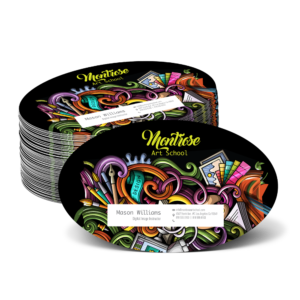
Shape & Cut Specialty — die-cut into a shape that makes your card impossible to lose in a stack.
Foil & Metallic Finishes — shine and dimension that catches the light and the eye.
- Raised Foil Business Cards — a single foil color with raised texture.
- Dual Raised Foil Business Cards — two foil colors on one card.
- Foil Worx Business Cards — full-color print plus foil accents.
- Akuafoil Business Cards — a flatter, budget-friendly foil effect.
- Pearl Metallic Business Cards — a shimmering pearl-finish stock.
- Raised Spot UV Business Cards — thick, glossy raised ink (not foil, but similar impact).
Want the full breakdown of how each foil option is made and how they compare side by side? Read Foil Business Cards: The Complete Guide.
Unique Stocks & Textures — cards you choose by how they feel as much as how they look.
- Painted Edge Business Cards — a solid color painted along the card’s edge.
- Black Edge Business Cards — thick 32PT stock with a black-painted edge.
- Linen Uncoated Business Cards — a textured, fabric-like uncoated stock.
- Natural Business Cards — an eco-friendly, uncoated natural stock.
- EnduraACE Business Cards — a waterproof, tear-resistant synthetic stock.
- Magnetic Business Cards — sticks to any metal surface.
- Plastic Business Cards — clear, durable 20PT plastic.
- Brown Kraft Business Cards — a rustic, uncoated kraft stock.
- Suede Business Cards — a soft, velvety laminate finish.
- Silk Business Cards — a smooth, elegant laminate finish.
Paper Types & Stock Weights, Explained
Two different measurement systems show up on our product pages, and they measure different things:
- PT (point): a direct measurement of thickness, in thousandths of an inch. 14PT and 16PT are the two most common business card thicknesses; 32PT (used on our Black Edge card) is roughly double the thickness of a standard card.
- LB (pound): a paper industry weight measurement, used mostly for uncoated and specialty papers like our 100LB Cover Linen stock. Higher numbers generally mean a heavier, sturdier sheet.
- C2S stands for “coated two sides” — a smooth coating applied to both faces of the sheet before printing, which is what most of our standard and specialty cards (14PT C2S, 16PT C2S) are built on.
- Uncoated stocks (like our Natural, Brown Kraft, and Linen options) have no coating at all, giving a more matte, tactile, and often eco-friendly feel.
- Synthetic stocks like EnduraACE (a waterproof polyester-based material) and Plastic (clear PVC) aren’t paper at all — they’re built for durability in wet or heavy-use environments.
Coating & Finish Types, Explained
- No Coating: a natural, matte, uncoated feel — easy to write on, no glare.
- Aqueous Coating: a water-based coating that adds a light protective sheen without much added gloss.
- UV / Gloss Coating: a high-shine, liquid coating cured under UV light for maximum protection and pop.
- Spot UV: a thick, glossy UV coating applied only to specific design elements (like a logo), leaving the rest of the card matte for contrast.
- Raised Spot UV: the same idea as Spot UV, but built up thicker so you can feel the raised texture under your fingertip.
- Foil Stamping: a thin layer of metallic (or matte) foil pressed onto the card under heat, often combined with a raised texture — see our Foil Business Cards guide for the full rundown of foil options.
- Suede & Silk Laminates: a soft-touch or smooth plastic film laminated over the card for a distinct feel that also adds durability.
- Edge Painting: ink applied to the raw edge of a thick card stock (used on our Painted Edge and Black Edge cards) for a color pop most competitors don’t offer.
What Do 4/4, 4/0, 5/1, and 5/5 Mean?
These numbers describe how many ink colors print on each side of the card, written as front/back:
- 4 = full-color printing (the four CMYK process inks: cyan, magenta, yellow, black).
- 1 = a single ink color, almost always black.
- 0 = no ink at all — that side is left blank.
- 5 = full color plus one extra “hit,” such as a spot UV coating, foil stamp, or a spot color, layered on top of the four process inks.
So in practice: 4/4 means full color on both sides (our most popular setup). 4/0 means full color on the front only, with the back left blank. 4/1 means full color on the front with a black-ink-only back (handy for simple text on the reverse). 5/1 means full color plus a special finish (like foil or Spot UV) on the front, with a black-only back. 5/5 means full color plus that special finish on both sides — the most premium (and most expensive) combination.
How to Choose
Start with how the card will be used: everyday networking usually calls for a Classic & Everyday option; a design-forward brand benefits from a Foil, Metallic, or Shape & Cut card; and a durable, weatherproof need points toward EnduraACE or Plastic. Still not sure? Request a free quote and tell us what you’re going for — we’ll recommend the right stock and finish for your budget.
Browse every option at once on our Business Cards hub, or go deeper on foil finishes specifically in Foil Business Cards: The Complete Guide.